
BY FREDA MIKLIN
GOVERNMENTAL REPORTER
Arapahoe Libraries recently hosted one of their regular “community conversations” at Koelbel Library in Centennial to explore what to believe from printed, televised, and online sources, all of which purport to be delivering news—factual information—but may be doing something different.
The topic of the discussion was, “In the era of disinformation, how can we decode fact from fiction?” Which raises the question, just when and how did the word “disinformation” become so common in our lexicon?
The topic drew a full house of around 200 people, mostly over age 50, but that’s to be expected—folks who aren’t raising children are more apt to be available on weekday evenings to participate in community gatherings.
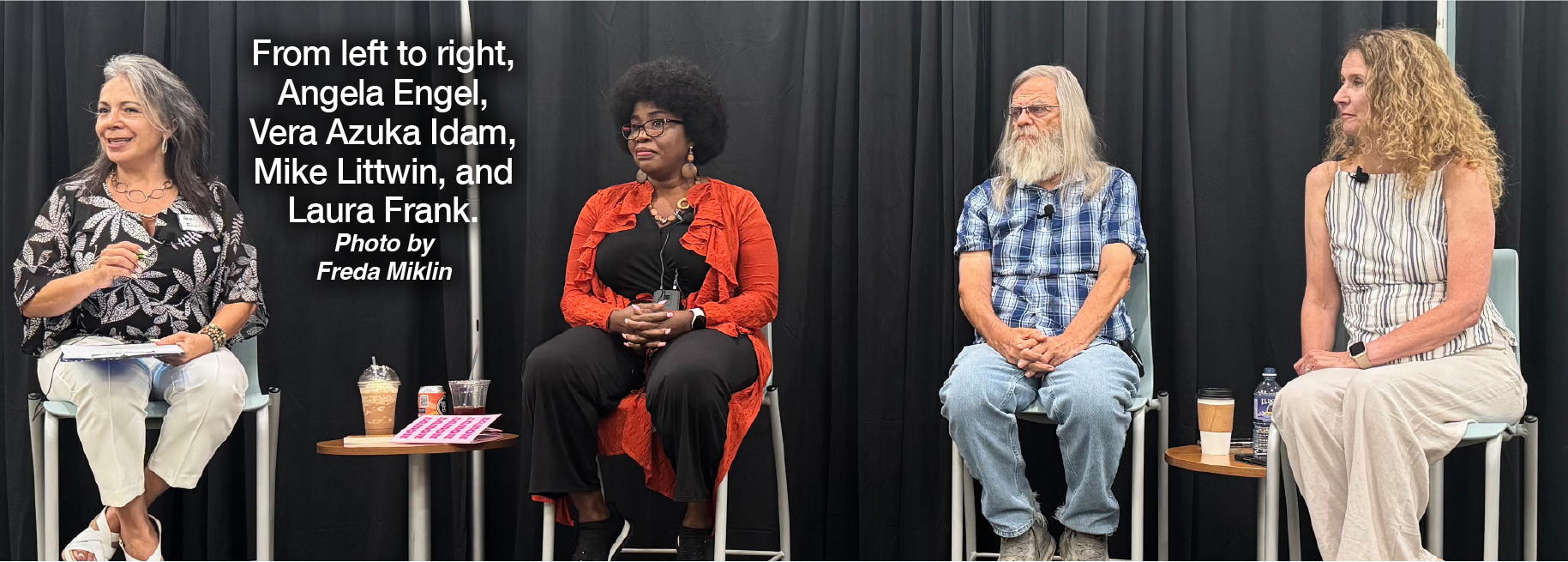
Laura Frank, University of Denver’s 2025 Wolzien Visiting Professor of the Practice in Research Informed Communication and recipient of media entrepreneurship fellowships at Columbia University and the University of Southern California, moderated the discussion. She currently serves as executive director of the Colorado News Collaborative (COLab), a nonprofit with 180 local news partners.
Panelists were Mike Littwin, a well-known Denver columnist. Starting in 1997, he has written for the Denver Post, Rocky Mountain News, and Colorado Independent, on topics from news to sports to popular culture and national politics, before landing at his current gig at the Colorado Sun.
Also on the panel was Angela Engel, M.A., a facilitator, writer, and educator, who currently teaches graduate studies at Marian University and has “empowered over 1,500 people with the skills and knowledge to advocate for their communities” through Colorado State University’s Family Leadership Training Institute.
Rounding out the group was Vera Azuka Idam, a first-generation African immigrant and publisher of Afrik Digest, who holds a B.A. in English from the University of Lagos in Nigeria and an MBA from the University of Phoenix.
Professor Frank opened the discussion by defining three key terms: misinformation— that which is false and misleading; disinformation—that which people know is false and misleading, and they share it anyway; and mal-information— spreading that which is known to be false and misleading with a specific intent to do harm.
The first audience member asked how citizens should deal with misinformation in the form of omissions. Professor Frank pointed out that there are fewer than half the number of reporters at Colorado news organizations than there were 20 years ago, so omissions could be innocent mistakes. At the other end of the spectrum, she talked about “pink slime,” a term used to describe organizations, some of which can be found in Colorado, that use AI to produce “news” that is borrowed from other sources but has an agenda, often partisan, that determines how it is presented.
Littwin talked about “how newspapers see what is and is not a news story.” Using redistricting in Texas as an example, he explained it is a news story because 1) it is being done at a time when it is not normally done—five years after the last census, and 2) there is such a small difference between the number of Democrats and Republicans in the U.S. House, that redistricting in Texas could determine the outcome of who controls the House after 2026. He added to that explanation, “The way something stays news is how people react to what is being reported,” and, on the topic of omissions in reporting, “Even if reporters are trying to be completely fair,” it can be difficult to include all the facts that matter in the limited amount of space available in newspapers or time allotted to broadcast news.
Asked how reporters avoid their own biases when writing news, Professor Frank said that she checks herself by not voting in primaries or displaying yard signs, which drew mixed reactions in the room, since one of those actions is private and one is public. She conceded that avoiding one’s biases “is an art, not a science.” For consumers of news, which is all of us, what is most important is recognizing biases in reporting. In a perfect world, editors will find and excise biased statements before a news report ever reaches the consumer, but with fewer journalists come fewer editors, thus the news consumer has a bigger job discerning biases and treating them accordingly.
Another audience member said she was disturbed by the idea that, “If people don’t react to the news, it’s not news and gets dropped.” She wanted to know, “Doesn’t the newspaper have a responsibility to persist on a story that needs to be talked about, whether people take an immediate interest or not?”
Littwin responded, “The Denver Post used to have over 300 people in their newsroom. Today, they have less than 50.” He used, as an example, affordable housing, a complex topic that “has lots of angles and is difficult to report, yet it’s important every day and has been for years in Colorado, and across the nation,” but there are not enough people to report this story correctly. He shared that when both the Denver Post and the Rocky Mountain News were viable newspapers, “The City of Denver had the highest penetration of readers of any city in the country.”
In response to another question, Littwin pointed out that reporting in some larger newspapers, like the New York Times and the Wall Street Journal, is done in a style that is intended to appeal to their target audience, something that readers should consider when consuming news from those and other recognizable sources. It is similar, though less obvious, to what discerning consumers of cable-TV news have learned to do when they watch it, especially in the evening.
Professor Frank pointed to a perennial problem that is more troublesome in our current age of highly divided politics: “People often conflate the editorials written for a news organization with the reporting, investigative or any other type,” because, she said, “News organizations have done a bad job of showing people how we know things. We don’t do a good job of describing the process, including that reporters are governed by a code of ethics and that there are editors who check reporters’ work before it ever gets to consumers.”
Another audience member said, “I am afraid for journalism in this country,” because some newspaper owners have far too much influence on “what’s printed and shared.” She cited the example of the impact Jeff Bezos has had on the content of the Washington Post since he became its owner.
Ms. Idam added, “We all have a responsibility to listen to and be attentive to the news that is going on around us. We have been bombarded with disinformation and misinformation. When you see news that does not confirm your biases, don’t conclude that it’s true or not true. Fact-check it yourself by seeking other sources of the same news.” The other panelists agreed that, while that is a tall order for most people, because everyone’s time is limited, it is the best way to get closest to determining what is actually true.